
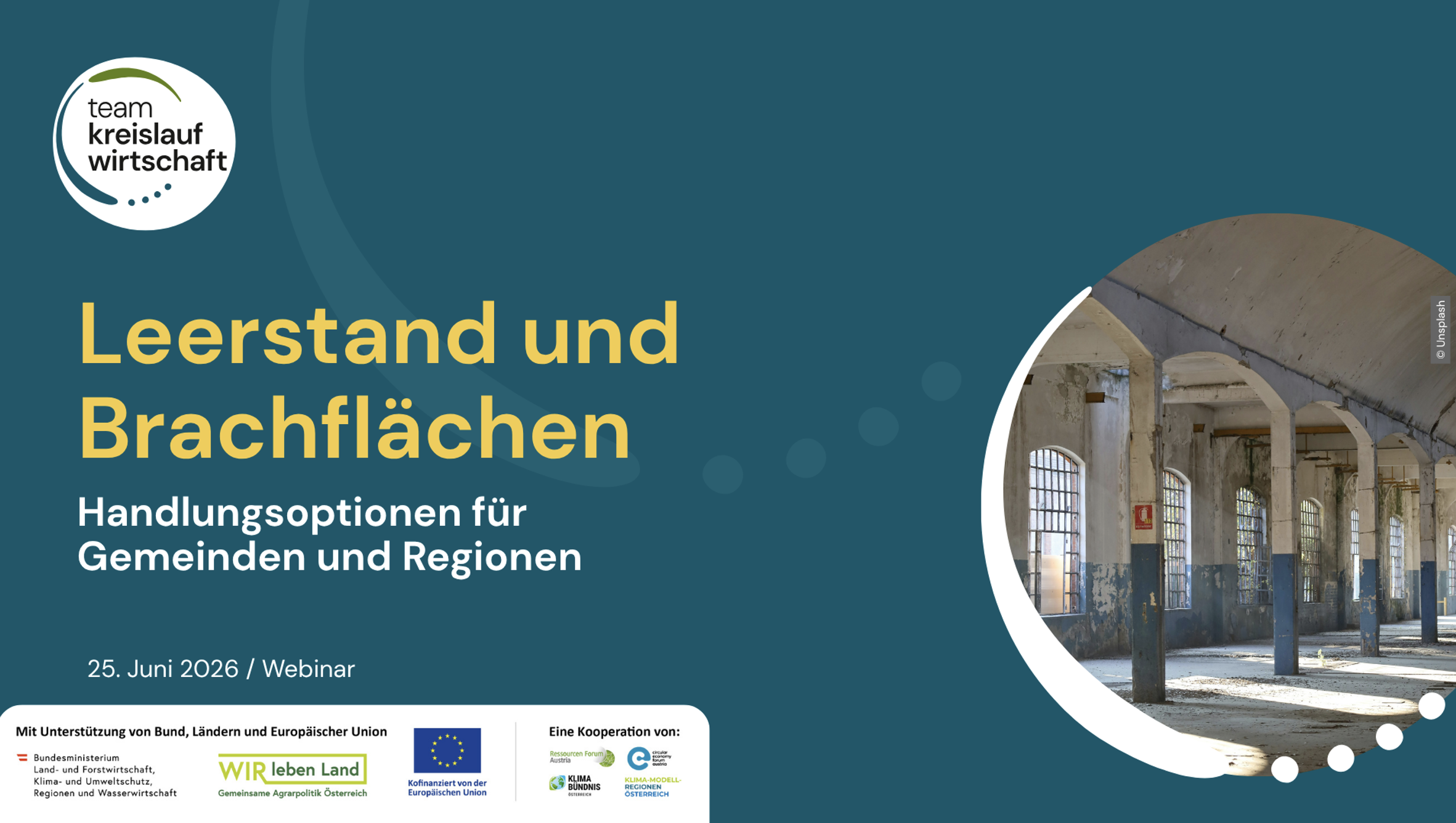
As part of the webinar series organised by the Team Kreislaufwirtschaft project, the topic „Vacant and derelict sites – options for action for local authorities and regions“ took centre stage on 25 June. Representatives from local authorities, regions, government bodies and planning organisations learnt how unused land can be put to good use and how existing resources can be further developed in line with the principles of the circular economy.
Vacant properties and brownfield sites are far more than just a matter of spatial planning. They are among the key areas of focus for a local circular economy. This is because, before new land is sealed off and new buildings are constructed, it is important to make the most efficient use of existing buildings, infrastructure and land for as long as possible. In this way, local authorities can conserve resources, reduce land consumption, strengthen town centres and make better use of existing infrastructure.
The webinar focused on the question of what options local authorities have for putting vacant properties and brownfield sites back to good use. The two speakers presented different perspectives: Sabine Rabl-Berger The Federal Environment Agency provided insights into the Austrian dialogue on brownfield sites, current tools for identifying potential sites, and the importance of land recycling within the context of sustainable land and spatial planning. Lukas Fürst He then used the development of the former Melk joinery as a practical example to illustrate how a joinery could be transformed into a mixed-use neighbourhood.
Right from the start, it became clear that vacant properties and brownfield sites should not simply be viewed as problem areas. Rather, they represent valuable development potential that local authorities can harness to further develop existing structures, reduce land consumption and make better use of existing infrastructure.
Sabine Rabl-Berger presented the Austrian Fallow Land Dialogue, which serves as a platform for exchange and cooperation between local authorities, regions, government bodies and other stakeholders. The aim is to pool knowledge, share experiences and support local authorities in making better use of existing land reserves.
A key point of the presentation was the importance of land recycling. This refers to the reuse of land that has already been developed, rather than developing new land on the outskirts of settlements. Land recycling is therefore an essential component of a resource-efficient circular economy. This not only supports environmental objectives such as soil protection, but also yields economic and social benefits. The revitalisation of vacant buildings or former industrial sites can help to strengthen town centres and enable new uses.
The link to the Austrian land use strategy was also highlighted. Sustainable urban development therefore means making more conscious use of existing resources and aligning development processes more closely with existing structures.
Another key focus of Sabine Rabl-Berger’s presentation was on new tools for identifying suitable sites. Among other things, she presented an AI-supported map of potential sites, which was used to identify possible development sites across Austria.
The map is intended to help local authorities gain a better overview of existing potential and identify possible sites for subsequent or renewed use. At the same time, it was emphasised that these tools are no substitute for detailed planning. The actual development of a site always depends on local conditions – such as ownership, land use designation, building requirements or potential contamination.
As well as identifying suitable sites, the discussion also focused on how local authorities can be supported in implementing projects. To this end, various support services and funding opportunities were discussed, which can be particularly helpful in the early stages of a project. It is crucial to prepare projects strategically and to combine existing funding instruments in a targeted manner.
In the second part of the webinar, Lukas Fürst presented the development of the Melk joinery workshop. The project demonstrates how an existing derelict industrial site can gradually be transformed into a new, multi-purpose neighbourhood.
A key principle of the project was a considered approach to the existing development. Rather than completely demolishing the existing buildings and rebuilding them from scratch, the team assessed which structures could be retained and further developed. Existing building elements, materials and resources were regarded as the starting point for further development. By phasing the work, individual areas can be developed further, whilst other uses within the site remain in place or are adapted. This process enables continuous development whilst taking existing resources into account.
It is precisely this approach that illustrates a fundamental principle of the circular economy: existing buildings, materials and infrastructure are not viewed as a burden, but as valuable resources. As a result, the materials, energy and infrastructure that have already been invested in are preserved for as long as possible.
Another key element of the project is the planned mix of uses. Housing, working (co-working spaces), services (e.g. yoga classes), culture, health (physiotherapy) and social interaction are to be brought together in a single location. The aim is to create a vibrant space that minimises distances and brings together a variety of needs.
Lukas Fürst emphasised that it is not just the buildings that matter. Rather, the aim is to create places that are used and brought to life by people. Architectural development is merely the foundation for a functioning neighbourhood.
Particular importance was attached to public participation. Lukas Fürst explained that members of the public were involved in the development process at an early stage and were thus able to exert a real influence. As part of a multi-stage participatory process, representatives of the public were involved, who later also formed part of the jury for the architectural competition. This form of public involvement was described as a key factor in the project’s success.
The experience in Melk showed that participation is particularly effective when it goes beyond simply providing information and allows people to take on genuine responsibility. In this way, local communities can not only foster acceptance, but also bring additional knowledge and new perspectives to development processes.
To conclude, Lukas Fürst summarised the key lessons learnt from the development of the site. One important insight, he said, is that neighbourhood development always involves regional development as well. Projects of this kind do not merely affect a single plot of land, but can provide impetus for entire regions.
Furthermore, it was emphasised that developments take time and must remain flexible. Particularly in the case of projects involving existing buildings, circumstances can change and new opportunities may arise. It is therefore crucial to remain open to adjustments and to support processes over the long term.
The issue of funding was also discussed. The project was made possible by combining various funding opportunities. The key factor was to make strategic use of funding and to view the development as a long-term process.
During the discussion, the participants focused in particular on the challenges faced by local authorities in revitalising vacant properties and brownfield sites. It became clear that ownership structures, funding and conflicting interests are often key issues.
One key point was the question of how local authorities can engage with property owners and win them over to a development project. The speakers emphasised the importance of active dialogue and early collaboration with various stakeholders.
The funding landscape was also the subject of in-depth discussion. It was emphasised that successful projects are often made possible by combining various funding instruments and that long-term strategic planning is essential.
Further questions centred on the role of the population in development processes. The example of Melk showed that participation can be particularly successful when citizens are not merely kept informed, but are actually able to play an active role in shaping the process.
In addition, the importance of mixed-use development was discussed. Combining different functions in a single location can help to strengthen town centres and create new meeting places.
The webinar demonstrated that vacant properties and brownfield sites represent significant development opportunities for local authorities. They are among the largest untapped resources in many local authorities and constitute a key area of focus for the local circular economy. Putting them to use can make a significant contribution to soil protection, the circular economy and sustainable local development.
The presentations made it clear that successful land-use development involves several interlinked levels: strategic planning, appropriate tools for identifying potential, suitable funding, and public engagement.
Whilst the dialogue on brownfield sites and the tools presented demonstrated how local authorities can better identify and utilise existing potential, the case study from Melk illustrated how a concrete transformation of existing developments can be successfully achieved.
Land recycling therefore means not only the reuse of buildings and plots of land, but also the development of new opportunities for local communities and regions. The key lies in a long-term, collaborative process in which existing resources are utilised and new qualities are created.
Further details can be found in the Recording below.

Site by Mad Nice Group GmbH
 German German
  English