
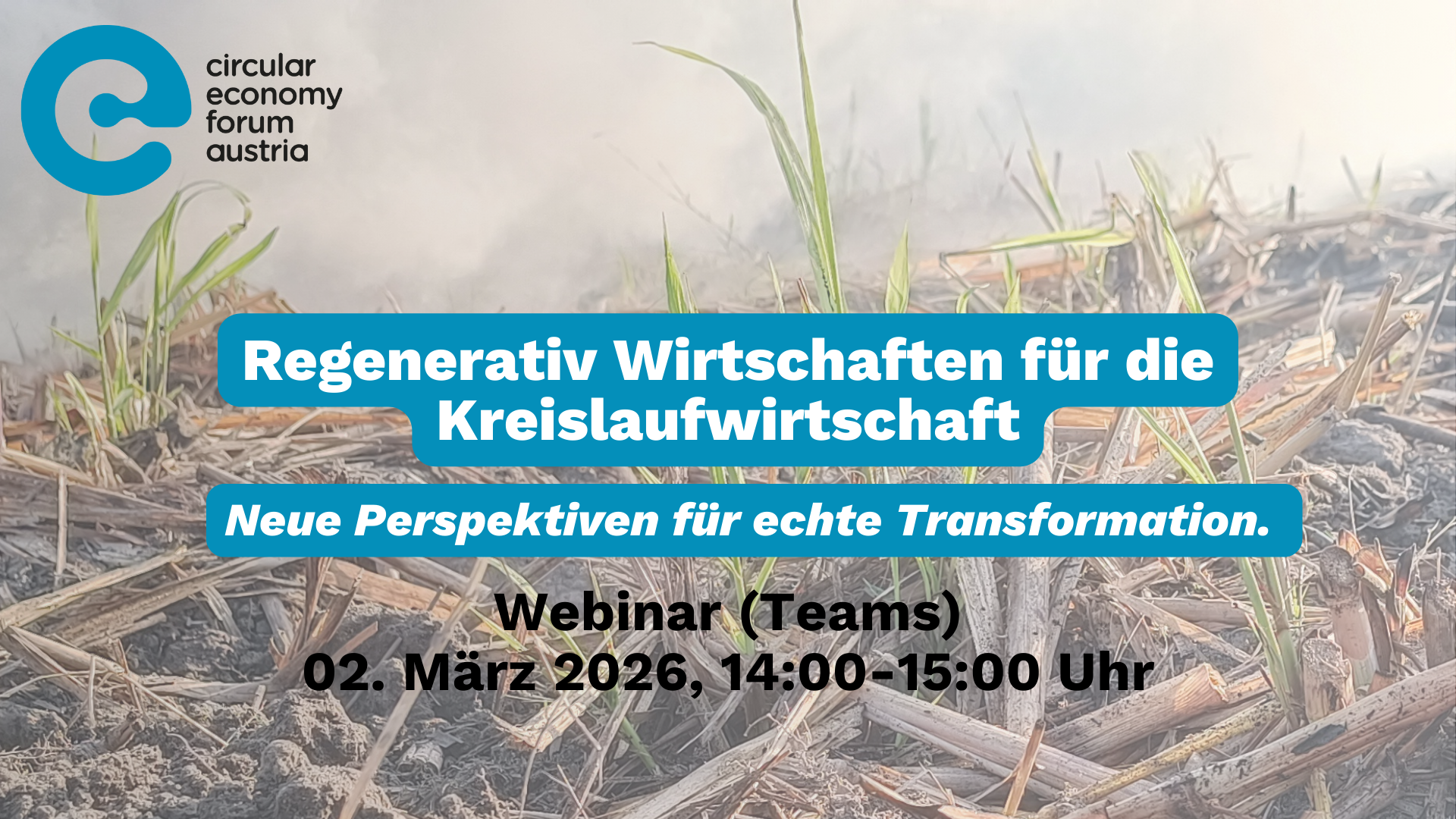
How can we not only do less damage, but also actively do good for our environment and society? Our webinar dealt with this key question „Regenerative management for the circular economy. New perspectives for real transformation.“
In the face of global crises and tangible planetary boundaries, it is clear that simply reducing negative impacts is no longer enough. We must take the step from a linear economy via the classic circular economy to a circular economy. regenerative economic system go. This means: independence through local value creation, maintaining our quality of life and creating systems that heal instead of exploit.
The most important insights and impulses from our speakers are summarised here.
Andreas Ellenberger (Advisor on Project Management, Circular Economy Forum Austria) and Andreas Melzer (member, Circular Economy Forum Austria) opened the event with a powerful image: it's about shaping a future that we want to live in. Livability is at the centre of this.
In order to drive this change in companies, a new understanding of leadership is needed - the Regenerative Leadership. This works on three levels:
Melanie Kraschitzer (Fellow at the Institute for Regenerative Economy) took us on a historical journey. She outlined the „Story of Separation“ - the story of how humans have become increasingly alienated from nature over the last few centuries.
This mechanistic and reductionist logic still characterises our economy today, often visible in the classic „silo thinking“ of many companies. The necessary paradigm shift requires us to see organisations and the economy as a whole again. living systems to realise this. This means opening up space for health, creativity, purpose and compassion in addition to finance and technology.
The classic circular economy (avoiding waste, increasing efficiency) was a milestone that was essential for survival, explained Mathias Behrens (Board of Directors fiveP / re:connect incubator for regenerative economies). But to heal the planet, we need to raise our ambitions - from „less bad“ to „net positive“.
He proposes a radical rethink of the familiar R-Strategies before:
Pioneering companies show that this is not a distant utopia: From Proservation (compostable packaging made from grain husks) via Biome (CO2-binding fungal insulation materials) through to the Industrial symbiosis Kalundborg, where the waste of one company is the raw material of the next.
In conclusion Moritz Meidert (Kommune Zukunft / Vierte Ort) gave a practical outlook. His central point: technical innovations in materials and processes are one thing - but without social innovations and in-depth cooperation along the entire value chain, we will not be able to close the loops.
The next step is to invite the Circular Economy Forum Austria on 27 May for the Reconnect Roundtable in: The focus is on the In-depth discussion of regenerative business models and the Exchange on proven good practicesand concrete Implementation steps.
Conclusion: An economy that promotes life is possible. The webinar showed that strengthening ecological and social cycles go hand in hand. Innovation, cooperation and a strong practical focus are the decisive levers for a resilient future.

Site by Mad Nice Group GmbH
 German German
  English