
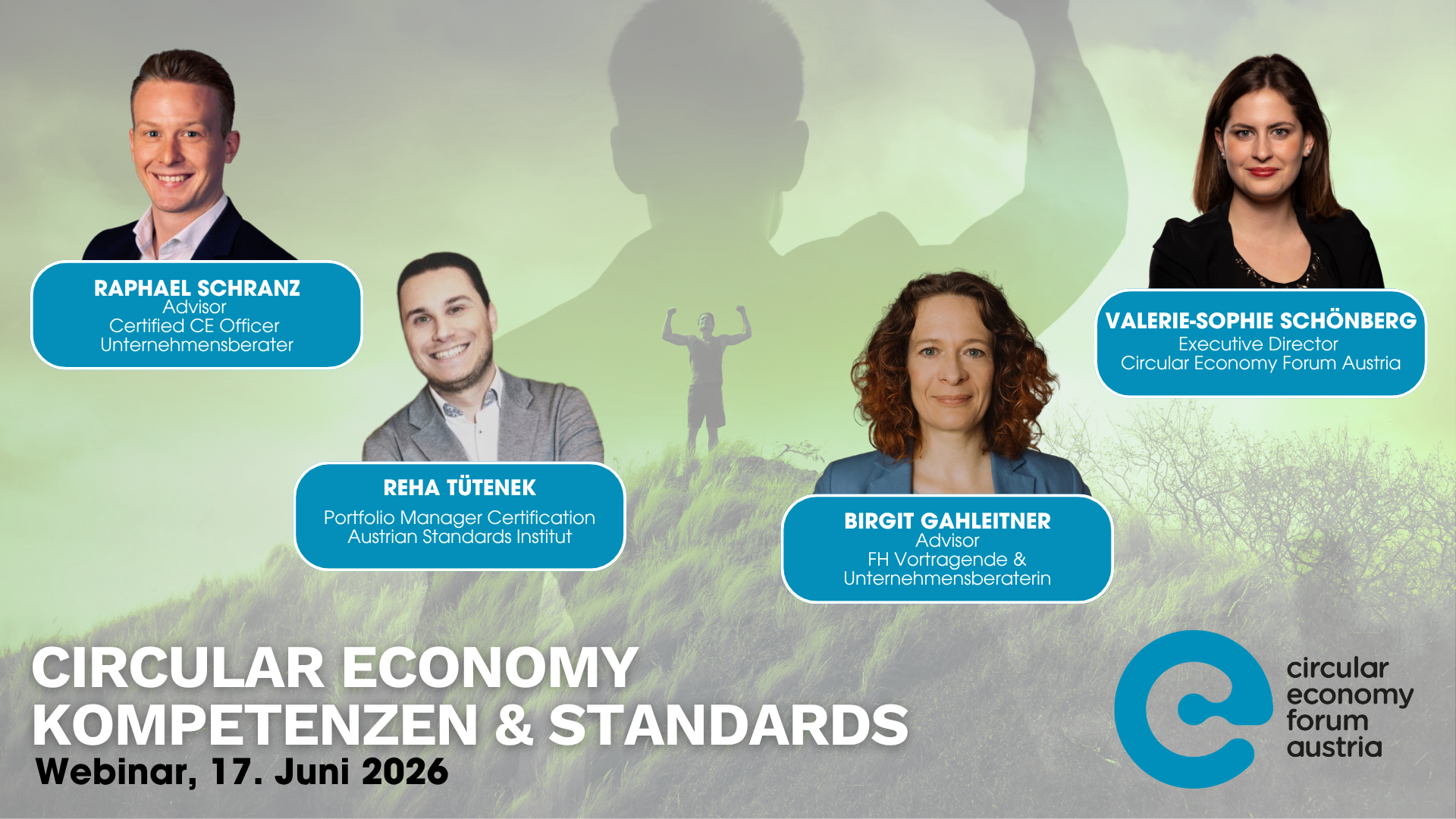
On 17 June 2026, the Circular Economy Forum Austria’s webinar explored the question of which skills, job profiles and standards are key to implementing the circular economy. The focus was on three areas: circular jobs and skills profiles, international standards within the ISO 59000 family, and education and training for the circular economy.
Circular jobs and new skills profiles
Contribution by Valerie-Sophie Schönberg, Executive Director of the Circular Economy Forum Austria
The circular economy is transforming not only products and business models, but also work, roles and skills profiles. Circle Economy (2021) classifies jobs in a circular economy into three groups:
New tasks are emerging across the entire lifecycle, from design, procurement and production through to use, repair, take-back, reuse, recycling, data management and organisational development. In this context, a competence encompasses more than mere specialist knowledge. It encompasses the interplay between:
The circular economy therefore requires clear skills profiles, new job roles, common standards and innovative training programmes that embed the circular economy more widely. Find out more about „Circular Jobs“ in the free online magazine CIRCULAR INSIDER AUSTRIA or in the reference work Handbook on the Circular Economy (2026) published by Linde Verlag.
Skills gaps, new job profiles and international examples
Contribution by Raphael Schranz, Certified Circular Economy Officer, management consultant and adviser to the Circular Economy Forum Austria
Raphael Schranz demonstrated that implementing the circular economy requires new skill sets. In addition to technical expertise, an understanding of economic interrelationships, scientific principles, system boundaries and the logic of cooperation is needed.
Key areas of expertise include, amongst others:
New or refined job profiles included, amongst others, Circular Designer and Circularity Manager ... International examples, such as those from 3D printing and prefabrication in the construction sector, demonstrated how circular approaches can influence resource use, construction times, reusability and cost-effectiveness.
Circular Economy in accordance with ISO
Input from Reha Tütenek, Portfolio Manager Certification at the Austrian Standards Institute
Reha Tütenek outlined the role of standards, competencies and certification in the circular economy. The ISO 59000 series marked the first publication of international standards for the circular economy in 2024. These standards establish common terminology, a consistent understanding and greater comparability.
The standards are interlinked in this context, functioning as a model of development and maturity:
This creates a clear path: understand, transform, measure, build capabilities and manage systematically. Standards are thus not seen as an end in themselves, but as a framework to guide the integration of the circular economy from individual projects into the organisation as a whole.
Education and training for the circular economy
Contribution by Birgit Gahleitner, lecturer at a university of applied sciences, management consultant and adviser to the Circular Economy Forum Austria
Birgit Gahleitner placed the focus on education and training. The circular economy should not be seen as an additional topic, but rather as a fundamental mindset and part of a broader understanding of circularity.
Circular literacy means, Cycles and Connections to understand the entire system, including:
In education and training, the circular economy is already evident in various formats, such as standard curricula, module weeks, seminars, guest lectures, university programmes and postgraduate further education courses. Relevant subject areas include decarbonisation, future thinking, circular product and service design, sustainable materials management, environmental economics, green marketing, sustainable leadership and future business.
Further reading:
Article: „Implementation through ISO standards“
Article: „Out of the linear one-way street“ – Certification as a Circular Economy Officer
The full Articles and details are available to watch again in the YouTube video:

Site by Mad Nice Group GmbH
 German German
  English