75 %
Companies are already working on the circular economy
Three quarters of the companies surveyed actively integrate the circular economy into their organisation.

Circular design is a decisive lever for the transformation to a circular economy. In Austria, the strategic importance is already increasing significantly - however, better economic framework conditions, stronger demand for circular solutions and targeted skills development are needed for broad implementation.
The results show: Circular design has arrived in Austrian companies, but needs better framework conditions for widespread implementation.
Three quarters of the companies surveyed actively integrate the circular economy into their organisation.
Today, 62 % already rate circular design as important or very important. For large companies, the figure is 85 %.
Many companies are already implementing individual circular design projects or are systematically take environmental criteria into account.
Particularly widespread are repair-friendly design and spare parts.
High investment costs, uncertain profitability and a lack of demand make widespread implementation difficult.
Discover key findings, good practices and recommendations for the broad application of circular design in Austria.
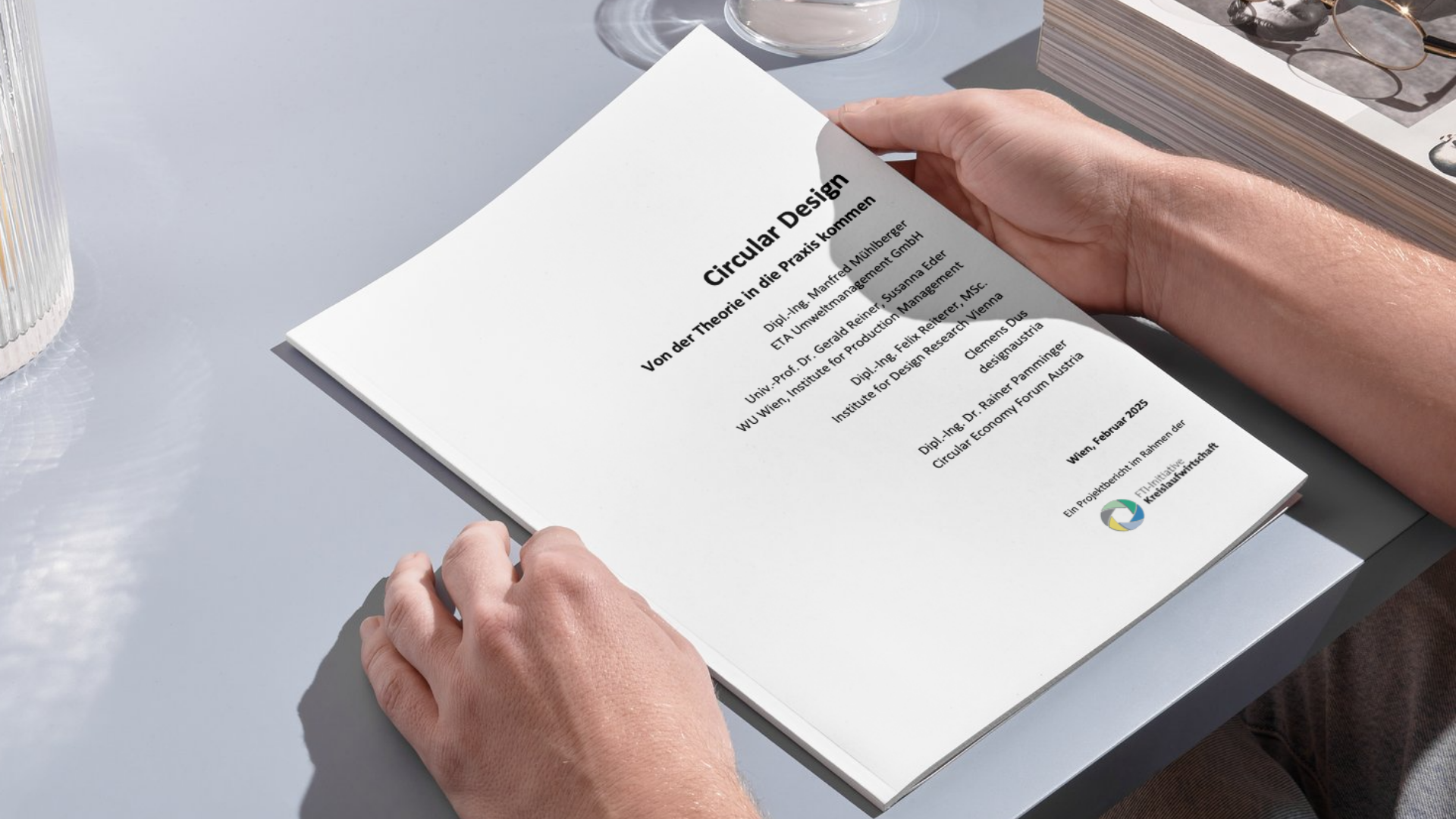
The report „Circular design - moving from theory to practice“ systematically analyses the status quo of circular design in Austria for the first time. The aim was to analyse the extent to which circular product design is already widespread in companies and among designers and what measures are needed to significantly increase its use.
Circular design - i.e. the recyclable design of products and service systems - is a key lever for the transformation to a circular economy. Decisions made during the design phase have a decisive influence on the service life, reparability, choice of materials and recyclability of a product. This means that a large part of the environmental impact is determined at an early stage.
33 % have already anchored the circular economy in their business model. Three quarters of the companies surveyed are actively working on integrating circular economy principles into their organisation.
Already today 62 % of companies consider circular product design to be important - for large companies even 85 %. The importance of circular design is expected to increase significantly by 2030. However, designers are still rarely involved: Only 13 % of companies have worked with designers on the topic of circular design to date, although they themselves rate the importance and their own knowledge of the topic highly.
Around 60 % of the companies are already implementing individual circular design projects or systematically integrating environmental criteria into product development. Examples from Zumtobel and Fronius show the way.
Repair-friendly design and spare parts offers are implemented particularly frequently, while circular business models or take-back systems are still rare.
High investment costs, uncertain profitability and low demand for circular products are currently slowing down the widespread implementation of circular design.
In order to establish circular design more strongly in Austria, the report recommends in particular
The R&D service was provided as part of the RTI initiative Circular Economy (3rd call for proposals, 2023) in cooperation with Circular Economy Forum Austria, designaustria, Institute for Design Research Vienna, ETA Umweltmanagement GmbH and WU Vienna, Institute for Production Management. More information here: https://fti-ressourcenwende.at/de/projekte/kreislaufwirtschaft/circular-design.php

Site by Mad Nice Group GmbH
 German German
  English